|
|

Prof. Stanislav
Pejovic, Ph.D., P.Eng.
1411
- 300 Webb Drive
Mississauga,
ON, L5B 3W3, Canada
Tel: 905-896-1253
Cell:
416-270-8126
E-mail:
pejovics@asme.org
Website: http://individual.utoronto.ca/StanPejovic
Stanislav Pejovic
Nick names: Stan and Cane
Table
of Contents at the end
Frequently updated on
or
http://individual.utoronto.ca/StanPejovic
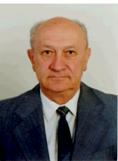 I was born 1933 in Belgrade, Serbia, what
was Yugoslavia at that time, where I lived until 1997, when I immigrated to
Canada.
I was born 1933 in Belgrade, Serbia, what
was Yugoslavia at that time, where I lived until 1997, when I immigrated to
Canada.
1
Immigration
to Canada and Citizenship
I immigrated to Canada on October 30, 1997
Citizenships: Canadian and Serbian.
2
My family
My family is of ancient origin from Montenegro. Few centuries ago, running
away from Turkish terror and blood feud, the family settled in a small village
Draca near Kragujevac. Even today
on the local cemetery, there is a small old tombstone to Stanislav Pejovic who
has been the first Pejovic in Draca. My father Tadija, PhD was born in Draca
(1892 - 1982) He was Professor of Mathematics at the
University of Belgrade. My mother Ljubica Pejovic
(1896 – 1980), born Vuckovic was teaching Math as
well. My Brother Pavle (1929 – 1994), PhD Engineer
was Professor of Computer Sciences at the University of Belgrade and Novi Sad.
My elder daughter Dana Bradic – Pejovic, MBA is with
Election Canada in Ottawa, and second one Ana Pejovic – Milic, PhD is professor
at Ryerson University, Toronto, Ontario, Canada and concurrently at the
University of Hamilton, Ontario Canada. I have three
grandsons: Mihailo, Luka, and Mark.
My wife Zagorka, Zaga was teaching Chemistry at the Faculty of Applied Arts, Department of Ceramics and Glass. She always wanted to be an engineer, but it happened to her to plug her hands into the shapeless mass of clay and created arts. Ceramics become obsession for her. She loved arts, she loved ceramics. Photos of some beautiful arts, for arts lovers could be admired in the book “All About Zaga” by Katarina Jovanovic, also on this DVD and my website http://myelab.net/cane/Sve o Zagi Pejovic_small size.pdf.
3
Student at the University of Belgrade
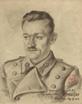 My
university education started at the University of Belgrade in 1952. Having
Option Hydraulic Energy at the Faculty
of Mechanical Engineering my
early study and my Diploma work (BSc Thesis Three-Dimensional Axially
Symmetrical Compressible Flow in Compressors) were my first writing on internal
flow in turbomachines; My first article An Approximate method of Calculating
Three Dimensional Compressible Flow in Turbomachines was related to my diploma
work (see 26 Appendix
B Thesis).
My
university education started at the University of Belgrade in 1952. Having
Option Hydraulic Energy at the Faculty
of Mechanical Engineering my
early study and my Diploma work (BSc Thesis Three-Dimensional Axially
Symmetrical Compressible Flow in Compressors) were my first writing on internal
flow in turbomachines; My first article An Approximate method of Calculating
Three Dimensional Compressible Flow in Turbomachines was related to my diploma
work (see 26 Appendix
B Thesis).
My mentor, Prof. Nikola Obradović, the academician and professor, Chair of the Department for Hydraulic Machines invited me to apply for the assistant position.
4
First “Energoprojekt”
Waiting to be posted at the University of Belgrade Prof Obradovic suggested and helped me to get employment at “Energoprojrkt,” Belgrade, Serbia, Yugoslavia. As of 1959 till late eighties I was engineer and consulting engineer first as a full time employee and then as a part time having office and working as much as it was necessary, at least half the time. As a young engineer I joined the team (Team leader Ing. Aleksandar Konstantinovic - Sanji and technical manager Ing. Josip Hvoj) of experts in 1959 learning and then designing and constructing the hydroelectric plants at various stages: Feasibility study, general design, detailed design (after bidding), tender documents for many hydroelectric, pumped-storage and pump plants as well as hydraulic system for other electric plans.
5
PhD at the University of Belgrade
|
|

After a brief industrial career, I started my academic career in 1960 at the Faculty of Mechanical Engineering where I worked until 1998. All the time I was designing, reviewing, troubleshooting, researching and developing technical innovations as a member of Prof. Nikola Obradović’s group. My research work has been focused in particular to the internal flow in turbomachines. More personally, Professor Krsmanović was an Assistant Professor and the youngest colleague when I joined the group. His knowledge, skills and patience helped me finish my Ph.D. thesis. He was always responding promptly and thoughtfully to all of my questions. Beside all help on many aspects of my research and teaching, Ljubisav (Ljuba) also provided me with friendship and many pleasant moments to remember. This lead to my Ph.D. thesis “A Contribution to the General Theory of Three-Dimensional Axially Symmetrical Flow in Turbomachines” (1964) (see 26 Appendix B Thesis).
In the following years I was dedicated to the work on subjects
related to energy generation, testing, maintenance, and optimization of
hydroelectric and pumping stations as well as on engineering education.
Furthermore, I designed pumps, and laboratory test systems and my work was also
rooted in promoting, understanding and solving problems related to rotating
machines (turbo-machines), energy generators, transient analyses, and design of
machines and systems. Professor Ivo Vuskovic
and Dr. H. Klein (Austrian concern Vereinigte Östereichische Eisen
und Stahlwerke (VÖEST) from Linz) constracted a big experimental installation
for testing models of turbines and reversible pump-turbines and I analysed
hydralic transients (waterhammer).
6
Alexander von Humboldt Scholarship
In 1966/67 as Alexander von Humboldt scholarship holder I continue post doctoral
learning, writing articles and experimenting in the laboratory at the Pfleiderer Institute for Turbomachines, University of Braunschweig (Pfleiderer-Institut für
Strömungsmaschinen) with Professor H.
Peterman.
Three articles in German, three in English and four in Serbo-Croatian related
to my PhD thesis and work in Germany were published. Later
on in time period from 1986 to 1992 I visited the University of Hannover and
spent about 14 months in Institute for Turbomachines (Institut
für Turbomaschinen) with
Prof. M. Rautenberg and Institute of Fluid Mechanics and Computer Applications in Civil
Engineering (Institut für
Strömungsmechanik und Elektronisches Rechnen
im Bauwesen) with
Prof. W. Zielke.
In 1986 the West Germany Ambassador
in Yugoslavia presented to me officially the most modern IBM personal computer,
printer and plotter as the Alexander von Humbodt
gift. This was one of the first PC at the Faculty for Mechanical Engineering,
University of Belgrade.
7
University Professor
As a
mentor, professor, reviewer and consulting engineer at the Universities and “Energoprojekt” I have transferred my knowledge and
experience to many generations of young engineers, in former Yugoslavia and
then in Canada. I wrote many books, articles, and studies. In addition I am
author of computer programs, and I have managed research projects and participated in research
projects. As chief engineer and team member, I participated in field acceptance
tests, field test, laboratory studies, laboratory acceptance tests and model
acceptance tests.
Prof. Aleksandar Gajic, was my best co-worker and PhD student; we, and other colleagues have been teaching at the University of Belgrade hydraulic systems and hydroelectric plants design for a century. (see 25 Appendix A)
In 2003 I was invited to the University of Toronto by Prof. Bryan Karney. As at that time there was no activity on subject designing hydroelectric plants I have initiated teaching new courses at the University of Toronto educating Prof Karney, his staff, and students Design of Hydroelectric Plants.
7.1
Short Courses, Seminars, Invited Lectures
At Universities, Ministries, Hydroelectric companies, and sites I have been teaching short courses, seminars, lectures, presentations and many other activities as listed on my personal website: http://www.stanpejovic.com/ or http://elab.rs/cane/ or
7.2
Personal Presentation and Updated
Autobiographies
Prof. Bozidar Radenkovic and my brother Prof. Pavle Pejovic both professors on Computer Sciences at the University of Belgrade, Faculty of Organizational Sciences, advised and helped me to write my first personal presentation. It has been posted as of 1997 and updated at the website: http://elab.rs/cane/.
In
2004 the link is posted at the University of Toronto website: http://individual.utoronto.ca/StanPejovic
8
At “Energoprojekt”
As designing and consulting engineer
I introduced and managed some new projects for the first time designed at “Energoprojekt.” They were:
1.
Pumping
plants,
2.
Pumped-Storage
Electric Plants,
3.
First
Waterhammer calculations,
4.
First
computer program for hydraulic transient analyses, 1967/78 was run on the first
computer in Belgrade, largely obsolete Elliott, having had only four control commands; all data
and programs were stored on punched paper
tapes about 1 cm, probably ½ “ width. This was also the first program
transferred on magnetic tapes and then personal computer in 1986. It was also
the first software programmed at the Faculty of Mechanical Engineering,
University of Belgrade, 1973,
5.
First
analysis to increase turbine power output.
8.1
Bajina Basta Plants – Vlasina Plant - “S” Instability - ASME Guide6
I have been learning the arts of designing! One of my first projects at “Energoprojekt” was Bajina Basta (4 units each 90 MW). A decade later I have designed four small powerplants on the River Vlasina (2x14 MW, 13 MW, 16 MW 13 MW) and the plant Lisina (2 pumps each 13 MW) pumping water into the storage of the Vlasina Lake. All four plants Vrla 1 to 4 had 50% electromechanical equipment in operation and civil works had been completed. The task was to add other units and increase the power output as much as possible. Analyses and designs confirmed the system has been safe and the output increased by 20%; but pumping additional water into Lake Vlasina for 300 m production has increased much more as the total head for all four Vlasina plants was 800 m.
After that, being an experienced engineer I have designed the pumped-storage electric plant Bajina Basta having two, at that time, highest head pump-turbine each having 300 MW. I was the first one performing technical analyses; the slogan “extrapolate only one characteristic” has been strictly followed up and only the pump-turbine head was higher than present plants in operation had. Based on the information that cavitation erosion is proportional to the 7th power of the head the submergence was calculated to prevent the incipient cavitation.
As the result of transient and vibration analyses, we discovered and published for the first time the pump-turbine “S” form instability (Pejovic S., Krsmanovic Lj., Jemcov R., Crnkovic P., Unstable Operation of High-Head Reversible Pump-Turbines, IAHR 8th Symposium, Leningrad, 1976). The peaks of pressure fluctuations exceeded the 900 m design penstock pressure head. In addition the underground power plant consists of a waterway, each feeding two units. The penstocks drop directly from the surge tank to the powerhouse and divide to feed two pump-turbines. The draft tubes join into a long tailrace tunnel leading to the outlet. The units in a loop intensified the “S” form instability making it extremely dangerous. As our team was not aware of this, we opposed the Toshiba proposal for each unit to have its own penstock in order to reduce the price for electrochemical equipment for10%.
Had I
known the “S” form characteristics danger I would have insisted separate
waterways. Had Toshiba known this runaway instability it would have forced us
to construct two separate penstocks and tailrace tunnel; but it did not. Therefore
the reasonable late solution was introduced. The philosophy of the governing and protecting
system was changed to prevent a parallel runaway of the both units at full
flow. The problem is solved if all protective devices properly respond in all critical
transients protecting units’ hydraulic resonance in the “S” unstable zone. If
not, pressure transient peaks would exceed the design limit of 900 m pressure
head. Therefore, each unit has two closing devices, wicket gates and penstock
ball valve.
To point out that I was the first
discoverer of the “S” form instability, let us take a case of the turbine
efficiency negotiation. We had compared two bids; one 91% and the other 89%;
this 2% was equal to a small 12 MW plant and for that reason we had aggressive
discussion with Toshiba to increase the efficiency, but there was no way.
Finally the acceptable proposal was of 91% efficiency but without warrantee
because the runner blades have had to be thin for 600 m head. Understanding
this important reason we accepted 89% efficiency. If Toshiba had known the “S” instability they
would have been much more aggressive to force us away from instability risk.
In this example the client’s
designers identified the dangerous phenomenon. The manufacturer verified this
instability and the control system were altered to prevent two units
simultaneous runaway; the most dangerous catastrophic case. Probability that
four protecting devices – two spherical valves and two guide vanes fail to
close is very small. But the risk is still present.
8.2
Draft Tube Water Column Separation
The Bajina Basta draft tube water
column separation had been analysed at the design phase. At my demand the
manufacturer analysed and confirmed that pump-turbines submergence of 54 m
would protect system from cavitation and water column separation in all pump,
turbine and transients’ mode of operations.
In
2008, about thirty years later new experience has been accumulated:
(i) analyzing water column separation in Iranian Masjed-e-Suleyman Hydroelectric Project (2000 MW; eight units each 250 MW) having long tailrace tunnel, and
(ii) editing and
updating the second edition of the Guide to Hydropower Mechanical Design,
prepared by ASME HPTC (American Society of Mechanical
Engineering Hydro Power Technical Committee) published by HCI Publications 1996, the water
column separation in the Bajina Basta draft tubes has been noticed in some old
diagrams. The calculated pressure in
the draft tube was below the zero pressure; therefore dangerous water column separation
could have occurred followed by severe rejoining in the draft tube and runner.
The already adjusted control system has protected units to run through the
unstable “S” zone prevented a runaway, particularly the simultaneously runaway
of both units. It is therefore highly improbable the all four closing devices
would fail to close, but a careful maintenance must keep them operable at any
and all the time.
The water column separation in
runaway has not been noticed by the team of engineers, of which I was the
member, and was not indicated by manufacturers and other experts involved in
the design and construction of the Bajina Basta pumped storage plant. Later on
additional analysis of the field test results has shown the pressure jump for 4
bar up to 10 bar in the draft tube in the case of one
turbine load rejection. The transient calculations in unstable zone are
uncertain and the error is unpredictable, in addition transients are
unrepeatable as chaos is, and therefore careful maintenance is the only way to
protect from a serious accident.
In conclusion: High head, low
specific speed pump-turbines (and pumps) should be carefully managed,
maintenance and frequently inspected by experienced experts.
9
Awards6
9.1
Life Time Achievement Award
This award was given by the
Honourable Lieutenant Governor of Ontario on behalf of National Ethnic Press
and Media Council of Canada for outstanding services in the field of science
and technology and dedicated involvement in community service. The Award recognized a Life Time Achievement
in the sector of Science and Technology and recognition of such services for
the betterment of mankind.
10 Serbian Academy of Sciences
and Arts
10.1
The best at the Faculty for Mechanical Engineering
All Full Professors at the Faculty
of Mechanical Engineering, University of Belgrade gave their secret ballots in
1991 to nominate candidates for election to the Serbian Academy of Sciences and
Arts and I was the first to be elected and the second was Prof. Djordje Zrnic. The Dean Milan Radovanovic was late to submit the letter of nomination; he
apologised and explained his reasons but my personal opinion has been that he
did not want to nominate us as we were not members of Communist Party; he
wanted somebody else to be elected! May be I am wrong? Who knows? But it has been my greatest honour being
elected by my colleagues Full Professors as number one!
10.2
Nomination
In the mean time Miroslav
Nenadovic, Secretary of the Department of Technical
Sciences initiated my election but he suddenly passed away. Later Secretary Petar Miljanic has not supported
my nomination. By the way, the candidates nominated by Academy Departments were
usually as a rule elected as members.
In addition Petar
Miljanic was my brother class mate and my “good
friend”. Many hydroelectric plants’ site tests we did together. I have never
asked him why he did not support my election and I have never tried to change
his opinion leaving time to do this. I think that my colleagues, full
professors at the Faculty of Mechanical Engineering were better informed about
my qualifications then the members of the Academy having only few mechanical
engineers and not a single hydro mechanical engineer.
10.3
My Father Nomination
History repeated! My father was not
elected as a member of the Serbian Academy of Sciences and Arts when applied.
Later when invited to apply, being too old did not acknowledge the nomination.
11 First Troubleshooting
11.1
Compressor volute burst
A centrifugal compressor in a
chemical factory was refurbished; the moment it ran in trial operation at zero
flow the cast iron volute burst. The pressure could not break it. The iron was
of a good quality; there was no fatigue. Power at no flow has been about 10% of
full load but was enough to increase the temperature in the air closed in the
volute for 200 C0/s. The heat transfer
through the iron was slow. The extension inside caused the volute to burst all
around. Had not the compressor outlet been completely closed and some leaking
occurred the accident would not have occurred.
11.2
Reverse waterhammer6
A butterfly penstock valve was
broken and few ten meters downstream the 4 MW Francis turbine cast iron spiral
case cracked all around and water was flowing into the machine house. The pin
connecting disk to the rod has broken and the butterfly valve disc closed
instantaneously. Water column separation occurred. The outside atmospheric
pressure decelerated out flowing water, returned it back toward the closed
valve to fill the void. The Joukowsky waterhammer was the source of a
pressure wave traveling at sound speed through the turbine. This was my first
investigation of waterhammer accident.
12
Canadian International Consortium - Masjed-E-Soleyman Project6
Immigrating to
Canada, I was a team member of Canadian International Consortium: Hydro
Quebec International & Rousseau Sauvé Warren International (RSW) in Iranian Company Farab,
Teheran, 1997, reviewing manufacturers’ drawings, calculation and booklets. The
“Masjed-E-Soleyman” feasibility study transient calculations pointed out
importance the analysis to be repeated based on manufacturers data.
Manufacturer’s transient analysis did not analyse water column separation in
the 400 m long tailrace tunnel. Being experienced, I have pointed out the
serious gaffe in the design of the "Masjed-E-Soleyman" hydroelectric
plant (4x250 MW units Phase 1 and another 4x250 MW units under construction Phase 2). My reports was supported by Canadian team leader Redouane Khris, but others
involved in this project (Lahmeyer International
GmbH, Institute for Fluid Mechanics and Hydraulic Machinery at the University
of Stuttgart, Germany; Voith Siemens Hydro Power Generation, Germany; Harbin
Electric Machinery Co. Ltd, Harbin, China) ignored draft tube
water column separation thus overlooking safety.
The commissioning of Phase-1 was started in 2002 but had as yet not been completed successfully due to the issue of water column separation in the tailrace tunnels, thus my early concerns were confirmed. To find solutions, the owner, appointed a Panel of Experts, I was member, to identify and address the causes of pressure surges. The experts’ reports and published article only analysed one special case and overlooked other dangerous cases. Therefore the new report (we have never been paid for by Lahmeyer International GmbH and owner) and articles have been written at the University of Toronto to educate experts and young engineers that the draft tube is the most complicated point of the overall hydraulic system.
13 ASME Guide
Furthermore, as the member of the ASME Hydro Power Technical Committee we have suggested the new edition of the Guide to Hydropower Mechanical Design to be updated adding the draft tube phenomena into Chapter 12 Hydraulic Transient, which I had initiated and prepared the chapter’s first draft in 1987. At that time I did not recognize that only three countries, Japan, Russia (former Soviet Union) and Serbia (former Yugoslavia) have been educated on the water column separation and related internal flow in the turbine draft tube. Now in 2009 the University of Toronto have been the only Western University teaching the phenomenon of daft tube water column separation.
There
has been a strong tendency on part of some engineers to focus attention on the
penstock and high pressure hydraulic works that leads up to or from, and
include the turbine or pump. This
practice implicitly relegates what comes after the turbine as an afterthought. Yet such an approach is dangerous, as many
important and potentially destructive hydraulic phenomena occur in, or as a
result of, the tailrace tunnel and pipes, particularly if they are long. These
accidents occurred in the low head turbines even when draft tube is very short.
The Zvornik Hydroelectric Plant Kaplan turbine
accident occurred in 1975 and the accident repeated a year later in
hydroelectric plant Ozbalt having identical runner
and blades. As a team member I investigated technical reasons to find an
explanation for the broken runner blades and damaged wicket gates and liners.
The police thought the terrorists had been involved. Contacting all people I
had chance to meet, I got a report on similar accident in the US and few
Russian publications. Professor G.I. Krivchenko from Moscow was invited to give lectures on the
subject. I recorded all his talks and two books were published. This was the
best class on hydraulic transient in hydroelectric plants. Furthermore he
taught us on the flow in the draft tube, which might well be argued
to be the most complicated part of the turbine system. Flow here is generally
multiphase, fully three dimensional, unsymmetrical, dominantly oscillatory but
with an unstable rotating vortex core at its middle. Such conditions make theoretical analysis
difficult and until today impossible, laboratory or numerical tests extremely
difficult, and even site measurements approximate.
14 Hydroelectric Plants
Design
Students in Ontario and North America, as we know, have never been taught, until now, a course on design hydroelectric plants and hydraulic auxiliary systems of nuclear, thermal and other plants. Professor Bryan Karney and I have been a team of enormous Bryan’s energy and political understanding of Canadian and University structure, and my knowledge and experience of teaching and designing hydroelectric plants and hydraulic systems.
The organized multidisciplinary transfer of experience has been a priority task to be undertaken by the University of Toronto and electricity sector in Ontario and Canada. There is a clear need to plan, finance and implement various long-term initiatives; it has been urgent that decisions to address this has been made. This task has been our priority at the University of Toronto; the learning from the experience of others working together allows for discovering new methods and styles.
Small or large electric plants design, construction and operation are complex tasks. Thousands of details must be well conceived and executed, and carefully coordinated for a project to achieve safe and economical operation that can be judged a social, technical and environmental success. Any hydroelectric installation, as a rule, should be designed using several stages as we had done at “Energoprojekt” and in former Yugoslavia for many years. At each stage, entire project documentation should be reviewed by independent reviewers selected and nominated by official authorities. Reducing the amount of analyses, without justification, or worse yet, neglecting the design procedures puts the project at risk.
We, at the University of Toronto, have been teaching experts to understand dilemma about the margin between smart design and expensive maintenance, or high technology and trial and error cheep designs - the expensive troubleshooting, or implementation of high technology, experience, knowledge, economy and stakeholder interests.
15 Projects6
Most of my projects have been troubleshooting. And then designing and analysing as well as site and laboratory testing.
16 Hydroelectric Plants
in Former Yugoslavia
In 1997 a meeting was organised by the
Scientific Society of Serbia and the University of Belgrade, Faculty of
Mechanical Engineering to study: Modern Technology in Hydroelectric Plant and
Machine Design; subjects:
(i)
On-Line Management and Control.
(ii)
International Seminar on Recent Trends in
Hydropower Plants & Machines (ISHPM);
(iii)
The Guide to Hydropower Mechanical Design
Prepared by the ASME;
(iv)
Upgrade, maintenance and new plants.
Important 68 experts from electricity sector and universities invited; 39 were present. The conclusion of the meetings and committees, I was the chairman, were:
- Subject: expensive electricity production, system uncertainty,
power plants aged, new generators urgently needed, drinking water systems
in a similar condition, water crisis rapidly approaching, modern industry
and agriculture is polluting the environment, developed countries are
major pollutant, long distance transportation for clean water, water crisis
will be harder than energy crisis, water means life or death, only who
have water will survive, sophisticated expensive water cleaning systems
will be built,
- Operating conditions in former
Yugoslavia: for about 15 year very little has been done to modernise and
maintain the generators and pumping systems, risk of accidents and
incidents is increasing, production more expensive, experienced educated
experts dispersed and new ones not introduced, many emigrate.
- Recommendations: institution
for new technology should be organised and financed until new economy
stabilises, introduction of new knowledge and technology, support new
experts, selection of experts, new projects, etc.
Documents in Serbian are posted on
my website:
(Link http://elab.rs/cane/cane_in_Canada/folders/Hydroelectricity_in_Yu)
(i)
why
the meeting,
(ii)
subject,
(iii)
invitation
letter,
(iv)
list
of invited,
(v)
list
of participants,
(vi)
conclusions
and
(vii)
recommendations, project proposal.
Many meetings with important persons
in electricity sector have no significant results because of the political and
economical crisis.
It is very
interesting and surprising that an undeveloped or may be under developed
country as Yugoslavia had same or very similar electricity problem like many
developed country including Canada.
17 Licences and diplomas
in Canada
As of 2002 I am
Licensed by the Professional Engineers Ontario (PEO).
Further on my Ph.D. and B.Sc. diplomas
in Mechanical Engineering were certified by University of Toronto.
17.1
English as My Second Language
To pass the Professional Engineering Law and Ethics exam I practiced to
improve my writing to answer a question in ten minutes. My brilliant English
teacher Mrs. Jean Corinthios, at the Adult Education
Centre South, Peel District School Board in Mississauga and my neighbours Rattanjeet, M.A. (Eng), PGDTE
(Post Graduate Diploma in Teaching English) and Dr. Bikram Lamba, all excellent in writing, reviewed my handwritten replies. I practiced
for about two months writing and rewriting texts to minimize the mistakes and
complete the text per question in ten minutes. The goal to write without
mistakes has was never been achieved but I passed the
exam. All replies were put together into two books which has been copied and
submitted to the engineers interested to practice writing Professionals
Practice Exams.
18 Ontario Electricity
I was almost blind; cataract closed my eyes, my vision had deteriorated. In 1999 plastic lenses replaced my covered ones. New energy was born. As yet being experienced as an engineer in electric plants and as a professor and head of Hydraulic Energy Department at the University of Belgrade I started immediately to learn and understand the Canadian and provincials’ electricity systems. Media articles, OPG (Ontario Power Generation) and IESO (Independent Electricity System Operator) websites, and privatisation provoked my interest and in 2002 letters were sent to very important persons pointing out the impending problems in electricity sector. The letters sent to some Very Important Persons authorities, posted on my website
19 Member PC Party
Policy Advisory Committee on Energy
My MPP Rob Sampson, after the meeting, sent the forms. I
filled them and as of January 2003 I have been the member of the Policy Advisory
Committee on Energy.
20
At Universty of
Toronto6
In March 2003 I was called by Professor Bryan Karney
to have a meeting at the University of Toronto.
Since then we have initiated our collaborative work on electricity
crisis in Ontario, and transfer of knowledge and experience. Immediately I have been invited to provide
presentations, lectures, reviews of journal papers, and joint
publications. We have had meetings with MPPs, Ontario Power Authority and businessmen. Our presentations, seminars, and new courses,
at the University of Toronto have been
one of the best methods for transferring knowledge and experience to young
experts. Professor Bryan Karney and I
have had some concerns and suggestions to practical implementation and possible
gaps in the legislations and therefore written submissions have been sent to
some Queens Park Committees, Energy Policy Advisory Committee, OPA (Ontario Power Authrity), and
some other authorities.
Ontario Government initiated solving procedure by responding to the electricity crisis in 2005 through the Electricity Restructuring Act, 2004. Prof. Karney’s and my concerns were further activated by the 2003 blackout causing loss worth probably Canadian $10 billion. Although the University of Toronto has not been directly involved in the electricity structures our discussions and presentation at Queens Park and meetings with Ontario MPPs accelerated the actions at the Ministry of Energy. Our nonpartisan actions have been based on research and development technology not easy understandable to politicians and investors educated in other directions. Therefore we continued our difficult action explaining the main technical issues. The new Division of Environmental Engineering and Energy Systems was created at the University of Toronto to educate how the electricity generation could be organized to work at the highest efficiency. Unfortunately, our action resulted in new courses related to wine and hydro electric plant design only; long term education of expert has not been supported by authorities.
21
Pulsatile
Flow Analysis of Human Blood Flow6
The analysis of
resonance and stability of bypass loop is essential and it is not fully and
sufficiently reported in the literature. A powerful mathematical method
developed for technical hydraulic systems (such as water networks, pumps,
hydroelectric plants and aeronautical systems), to study steady, transient and
oscillatory flow has been adopted. The oscillatory condition, which is excited
by the human heart, is calculated along the simplified bypass loop along with the
local vascular network. Moreover, same analytical approach is applied to a
coronary system of healthy vessels, which can be excited by an inside or
outside force. A wide domain of the frequency could be analyzed. Under the
theme of fluid mechanics, this research contribute to the understanding of
blood flow, by developing a numerical modelling using the method of
characteristic solved in time domain and Laplace and Fourier transformation for
analyses in frequency domain (response and stability). The aim of hydraulic
vibration analysis carried out in most recent years, by using design and
parameters typical in the human coronary circulation, has been to evaluate
conditions when the bypass graft functions safely, avoiding possible
undesirable effects to the patient. The resonance is the most critical issue,
always followed by blood pressure oscillation beyond lethal limit. Prof. Bryan
Karney, my daughter Ana Milic – Pejovic, teaching medical physics at Ryerson
University, teaching assistants and I have submitted the article “Pulsatile Flow Analysis of a Human Coronary
Artery Bypass” to the Journal of Biomechanics.” The applied methods being
mostly new to the biomedical reviewer have been returned back with comments
showing that reviewers have not been able to do a proper review. As the result
of our research work, we published 3 articles, developed computer programs in
time domain and frequency domain and have had several presentation and
seminars.
22 Troubles in Operation6
22.1 Chair at IEEE
Conference 2009
Panel Sessions Chair, Hydro Power and Storage
Technology. IEEE CANADA, Electrical Power and Energy Conference 2009, Sustainable
Renewable Energy Systems and Technologies," October 22 - 23, 2009 Montreal,
Quebec, Canada.
I have again been invited to Chair the Conference Sessions and continue action initiated two year ae at IEEE Conference 2007.
22.2
Chair at IEEE Conference 2007
Session Chair, Renewable Energy Resource in Canada and Abroad. IEEE Canada, Electrical Power Conference 2007, "Renewable and Alternative Energy
Resources," October 25 - 26, 2007
Montreal, Quebec, Canada.
Invited by Dr. Branislav Djokic, Member and Dr.
Bin Wu, Chairman of the
IEEE Electrical Power Conference 2007
Technical Program Committee I chaired two
“Hydro Power Technology” Sessions. Presented
articles, contributions and discussion summarized that over the past decade,
there have been several instances where the performance of new hydro
developments has been compromised by unsatisfactory operation of some component
associated with the hydraulic design of the facility. The main most important conclusions and recommendations have been:
1.
More than 50% hydroelectric plants have trouble
in operation.
2.
Continuity of knowledge and experience has been lost.
3.
Organized multidisciplinary transfer of experience is a priority
task.
4.
Action should be undertaken all projects,
including short‐changing, correctly to be designed and reviewed.
5.
Taking short cuts can lead – and indeed has
often led – to large‐scale problems
22.3 Design and
Construction Procedure
Based on experience and practice for transient and vibration analyses specified in the Guidelines to Hydraulic Transient Analysis, Pejovic S., Boldy A.P., Obradovic D. (1987) we have suggested that hydroelectric installations, as a rule, should be designed using the following stages:
(i) Feasibility study,
(ii) General design,
(iii) Detailed design (after bidding),
(iv) Commissioning and running-in process,
(v) Trouble-shooting investigations, and
(vi) Reconstruction, redesign, adjustment or enlargement.
(vii) Review at each stage.
Ideally, all project documentation should be reviewed at each critical stage by independent reviewers selected and nominated by official authorities. Short-changing the analyses, without justification, or worse yet, neglecting any design stage or its associated review, puts the project at risk. At stake here is the economical and efficient functioning of the whole project; taking short cuts can lead – and indeed has often led – to large-scale problems. The point here is that the design team, the project documentation, and the review process all play an interconnected role in anticipating and resolving difficulties before they are implemented in the field, and thus solving them when they are relatively simply addressed. There is no a single hydroelectric project running through the commissioning and trial operation without troubleshooting; thus a higher degree of review and documentation through project stages could pinpoint problems earlier and more effectively than later. Furthermore, this process, while costing only a small premium, would decrease troubleshooting and maintenance costs over the project’s life time. All my hydroelectric projects and reports done in former Yugoslavia have been reviewed and I have reviewed many projects and booklets done in “Energoprojekt,” former Yugoslavia, Canada and over the world. I have been always very happy other experts to review my work because this has been the most efficient way to improve knowledge and experience.
Hydroelectric plant’s equipment may have been designed in accordance with the highest standards and produced using the finest manufacturing practices, but this does not necessarily guarantee that equipment will operate properly when integrated in a system. Every hydropower project has unique design criteria. Unique characteristics of a particular installation can result in unknown and unexpected events during plant operation. For this reason, designs, reviews, construction, erection, start-up testing should be a carefully planned, step-by-step procedure that provides adequate projects, drawings, in short all documentation and data, for a thorough analysis of all operating conditions. All parts of the design should be reviewed to determine which items require analyses and to what extent. This is important, not only for new designs that lack proven operating records, but also, when a system is expanded and up-rated, since these improvements must be predicted and verified with accuracy.
(viii) Construction and inspection is an extra (obvious) stage.
Although this is an obvious step, an experienced and qualified eye during the construction process duly documenting details would be of importance for future troubleshooting and maintenance activities, as well as to proactively deal with issues which may impact schedule and performance of the installation. Some of my cases listed in are 29 Appendix E Construction and inspection is an extra (obvious) stage6.
23
Citation
I have been quoted in at least 200 books
and articles published by famous editors.
Prof. Stanislav Pejovic, Ph.D., P.Eng.
1411
-
Tel:
905-896-1253
Cell:
416-270-8126
E-mail: pejovics@asme.org
Website: http://individual.utoronto.ca/StanPejovic
24
Appendix A: Hydroelectric
Plants and Machines in Former Yugoslavia – Two Centuries of Experience
The construction of the first turbines in the countries of former Yugoslavia was designed to support the work of iron smelters. It was manufactured at Dvor, near Žeženberk (Slovenia) and was considered to be the oldest turbine developed in former Yugoslavia, made by Samassa family in the 18th centuries. After the First World War, companies in Livarne and Skofja Loka were producing Francis and Pelton turbines. At that time, the development of Kaplan turbines began in Belgrade as well by the Machine and Foundry Works - Pejić, Stefanović & Co. in Hiš.
In the eastern parts of Yugoslavia engineering progressed somewhat more slowly, but the first turbines constructed by local engineers were very successful and the Military Engineering Institute in Kragujevac, Serbia produced its first turbine in 1865 for the flow of 22 - 24 1/sec, at head of 27 m and speed of 229.3 rpm[1].
The first Kaplan turbine in Yugoslavia was constructed
in 1929 at the former Institute of Technology in Belgrade and tested by Prof.
Nikola Obradović, later the
academician and professor at the Faculty of Mechanical Engineering in
Belgrade and my B.Sc. and Ph.D. mentor.
|
|
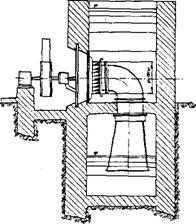
After the Second World War and nationalization of industry, the hydraulic machine production continued in the state company "Jastrebac," Nis and in August 1946, following a decision of the Ministry o Industry and Mining " Tito’s Co. Litostroj" was founded in Ljubljana (September 1, 1947). In the next year Federal Institute of Turbomachines, today "Turboinstitut", was founded as the part of "Litostroj". At the same time, Federal Institute of Energy "Jaroslav Cerni" for hydraulic civil engineering tests and commissioning of power plants, and Federal Electrical Engineering Institute "Nikola Tesla", Beograd were established to carry out in collaboration with the Faculties of engineering in Yugoslavia site tests and commissioning of electric plants. From 1950 to 1970 small turbines were designed, examined and constructed at the Department of the Hydraulic Machines of the Faculty of Mechanical Engineering in Belgrade. This unit was built in mini hydroelectric plants in Yugoslavia and Indonesia (Fig. 1) and it was the part of Prof. Krsmanović’s Ph.D. thesis. A small hydroelectric plant Ovcar Banja (units 2 MW and 4 MW) as the emergency source of electricity has this mini turbine.
Figure 1. Small turbines constructed in Yugoslavia after the Second World War was the part of Prof. Krsmanović’s Ph.D. thesis.
Small generators coupled with diesel motor were producing the first electrical light for illumination the small areas, first in Belgrade, 1880 and then in other towns. After 1929 an outstanding increase in electric energy production was achieved. The ideas of establishing an electro-system was presented at the Conference of the Electric Company Union of the Kingdom of Yugoslavia held in 1934, and standards for an electric grid was issued in 1937, but the system was not established at that time.
After the end of the World War II, the fast growth of industry required more electrical energy. In the period from 1945 - 1955, coal fired power plants were built, whereas from 1955, hydroelectric ones were constructed as well. The total output of Yugoslav generators was increased 41 times, which corresponds to an average increase of 9% per year. At the same time the consumption was increased 101,7 times, or 11% per year. At the end of 1989 the total power of Yugoslav electric plants was 21489 MW, where 8385 MW or 39% was hydro, and 13104 MW or 61% from coal fired electric plants.
Yugoslav electrical industry built large number of the hydroelectric plants, such as:
|
|
- Hydroelectric plant “Iron Gate I” (“Djerdap I:” 12 Kaplan units, 6 on the Yugoslav, and 6 on the Romanian side of Danube, head of 27.6 m, power 194 MW, speed 71.5 rpm, flow 600 m3/sec, runner diameter 9.5m, manufacturer LMZ, Leningrad, Russia, see Fig. 2.)
Figure 2. Hydroelectric plant Iron Gate 1. Professor Krsmanović and Pejovic Was involved in Its Construction
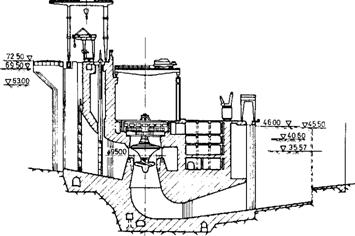
- Reversible Pumped-Storage Hydroelectric Plant “Bajina Bašta” (2 units: turbine operation 315 MW, head 600 m, speed 428 rpm; pumping head 531 to 621 m, discharge 39 to 51 m3/s, power 310 MW, manufacturer Toshiba, Tokyo, Japan, see Fig. 3).
- Other companies, which delivered component to Yugoslav Power Industry were: Andritz, ČKD, Charmille, Ganz-Mavag, Hydroart, KSB, Kvarner Eureka (Nohab, KMW), Litostroj, LMZ, Neyrpic, Sulzer-Escher Wyss, Toshiba, Vest Alpine, Voith.
This briefly describes the history of the hydro-energetic industry in Yugoslavia when Professor Krsmanović and a bit later Professor Pejovic joined the profession. They, along with our students, were involved in the construction of the most of Hydroelectric Plants that still operate in the Balkan Region and also participated in the production of hydraulic machines and ventilators in the former Yugoslavia.
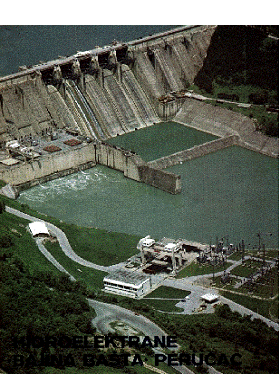 Figure 3. Pumped-Storage
Hydroelectric Plant “Bajina Bašta.” Professor
Pejovic initiated fusibility study and is responsible for all designs and
commissioning.
Figure 3. Pumped-Storage
Hydroelectric Plant “Bajina Bašta.” Professor
Pejovic initiated fusibility study and is responsible for all designs and
commissioning.
25
Appendix B Thesis
1. Pejovic S., A Contribution to the General Theory of
Three-Dimensional Axially Symmetrical Flow in Turbomachines (in Serbo-Croatian),
Thesis, University of Belgrade, 1964. <Full
text>
1.1.
PhD Thesis: Link to the Full Text (in
Serbo-Croatian)
1.2.
Articles related to the PhD thesis in German
1.3.
Articles related to the PhD thesis in English and Serbian
2.
Pejovic S., Three-Dimensional Axially Symmetrical
Compressible Flow in Compressors. University of Belgrade, Faculty of Mechanical
Engineering, 1958.
2.1.
Article
related to the BSc Thesis: Pejovic S., An Approximate method of Calculating
Three- dimensional Compressible Flow in Turbomachines (in Serbo-Croatian; Abstract
in English), Zbornik Masinskog
Fakulteta, Belgrade, 1959-60, pp. 8.1 - 8.