Bajina Basta Reversible Hydro Power Plant
World
Highest Head, High Speed and Large Capacity
(Low
specific speed)
This Web
Page aren't
supporting some features.
See: pdf version
or open this as WORD file
In 1960s I was working with a team of experienced experts
designing Bajina Basta Power
Plant (4x90 MW). Read more, They were my teachers. Few years later in about 1970 a Pump
Generating Station Bajina Basta project was initiated. In 1982 it was put in
operation.
Unexpected
trouble has been “S” instability discovered for the first time in 1970s. The first
explanation of the "S" form instability
phenomena was published by Pejovic et al. Link: http://www.stanpejovic.com/IAHR 1976 Leningrad S form
characteristics.pdf
Bajina
Basta Plants referred in the books
1. Pejovic S., The Rules to Hydraulic Transient Design Analysis for Investors, Designers, Manufacturers, Managers, 2017, under review
2.
Pejovic S., (Co-Author), The Guide to Hydropower
Mechanical Design, Prepared by ASME (American Society of Mechanical Engineers) Hydro
Power Technical Committee, 2014, new edition under review.
3. Pejovic S., Boldy A.P., Guidelines to Hydraulic Transient Analysis of Pumping Systems, P & B Press, Belgrade - Coventry, 1992, pp. 181. <The Book published in 1992>
4. Pejovic S., Guidelines to Hydraulic Transient Analysis (in Serbo-Croatian), Belgrade, 1984, pp. 119.
5. Pejovic S., Krsmanovic Lj., Jemcov R., Model and Field Tests of Hydraulic Transients in Hydraulic System (in Serbo-Croatian), Masinski Fakultet, Belgrade, 1978, pp. 34.
Articles:
1.
Pejovic S., Zhang. K.,Q., Karney, B., Gajic A.,
Analysis of Pump-Turbine “S” Instability and Reverse Waterhammer Incidents in
Hydropower Systems, 4th International Meeting on Cavitation and
Dynamic Problems in Hydraulic Machinery and Systems, Belgrade, October 26-28,
2011,
2.
Pejovic S., Pressure
Surges and Vibrations in Hydropower Plants - Experiences in Yugoslavia, The
Current State of Technology in Hydraulic Machinery, International Editorial
Committee Book Series on Hydraulic Machinery, Gower Technical ,1989, pp.
177-204.
3.
Pejovic S.,
Krsmanovic Lj., Jemcov R., Crnkovic P., Unstable Operation of High-Head Reversible
Pump-Turbines, IAHR 8th Symposium, Leningrad, 1976, pp. 238-295. <IAHR
1976 Leningrad S form characteristics.pdf>
4. Pejovic S., Zhang Q., Karney B., Gajic A., Key invited presentation, Analysis of Pump-Turbine “S” Instability and Reverse Waterhammer Incidents in Hydropower Systems, 4th International Meeting on Cavitation and Dynamic Problems in Hydraulic Machinery and Systems, Belgrade, October 26-28, 2011,


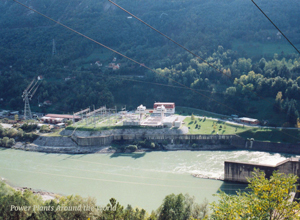
Fig 1 Bajina Basta storage and dam. This storage is the lower reservoir for Bajina Basta pumped storage plant. The roof and the crane on it is at the bottom of the tailrace.
Hydro Mechanical Design
As a part time designing and consulting engineer at "Energoprojet", Belgrade Prof. S Pejovic was responsible for hydro mechanical design of "Bajina Basta" pumped storage power station.
Best companies visited and the best selected as manufacturers.
Pump - Turbine Specifications
Type:
Vertical shaft,
single stage, single runner, Francis pump-turbine
Turbine:
Head: 497 - 600 m | | Rated head: 554 m
Output: 243 - 315
MW | | Rated output: 249 MW
Speed: 428.6 rpm
Specific speed:
73 m-kW
Pump:
Head: 532 - 621 m
Discharge: 37 -
51 m3/s
Speed: 428.6 rpm
Specific speed:
27 m- m3/s
Other data:
Runaway speed:
659 rpm
Transient speed
rise after full load rejection: 45%
Maximal penstock
pressure: 900 m
Submergence: 54 m
Model Tests
The pump-turbines in Bajina Basta pumped storage operate with the head exceeding 600 m. This was the record high head. The series of model tests had been performed to verify the hydraulic characteristics. The figure shows the model test setup (TOSHIBA REVIW).
Four
quadrant characteristics had so called unstable
"S" form. The first explanation of the "S" form instability phenomena was published by Pejovic et al. Link: http://www.stanpejovic.com/IAHR 1976 Leningrad S form
characteristics.pdf

Fig 2 Model test setup at TOSHIB’s laboratory
Transient Analyses
Transient computer analyses had been based on four quadrant model test characteristics. For the firs time the "S" form instability had been discovered by computer simulations as Fig 3 suggested. The peaks of pressure fluctuations exceeded the 900 m design penstock pressure head. The philosophy of the governing and control system had been changed to prevent a parallel runaway of the both units at full flow. The problem was solved if all protection devices properly responded in all critical transients. If not, pressure transient peaks would exceed the design limit of 900 m pressure head.
Water column separation and
Reverse waterhammer
The draft tube water column separation had been analysed at the design phase. On my demand the manufacturer analysed and confirmed that pump-turbines submergence of 54 m would protect system from cavitation and water column separation in all pump, turbine and transients’ mode of operations.
In 2008, about 30 years later, editing and updating the second edition of the Guide to Hydropower Mechanical Design, ASME HPTC (American Society of Mechanical Engineering, Hydro Power Technical Committee), HCI Publications 1996 the water column separation in the Bajina Basta drat tubes has been noticed in the diagrams (Fig. 3 and 4). The calculated pressure in the draft tube was below the zero pressure; therefore dangerous water column separation could occur followed by severe rejoining in the draft tube and runner. To prevent a runaway, particularly the simultaneously runaway, the closing devices of the both pump-turbines, wicket gates and penstock valves are closing atomically by the control system. It is highly improbable the all four closing devices to fail to close but a careful maintenance must keep them operable at any and all the time.
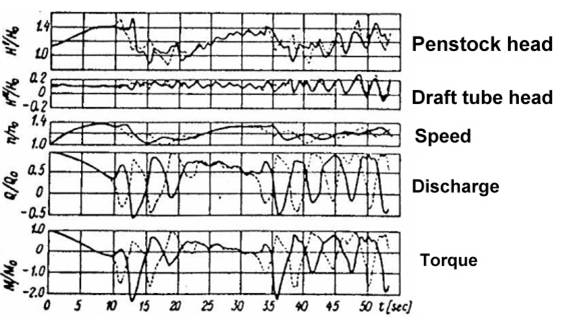
Fig 3 Two units runaway;
guide vanes and
inlet penstock valves are open;
both
pump-turbines run at full runaway;
calculated zero
pressure in the turbine draft tubes means water column separation
The water column separation in runaway has not been noticed by the team of engineers, I was the member of, and was not indicated by manufacturers and other experts involved in the design and construction of the Bajina Basta pumped storage plant. Later on additional analysis of the field test results depicted in Fig 4 shows the pressure jump for 4 bar up to 10 bar in the draft tube in the case of one turbine load rejection.
|
|
|
|
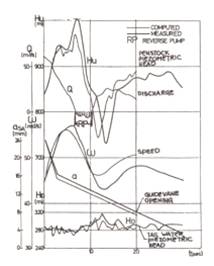
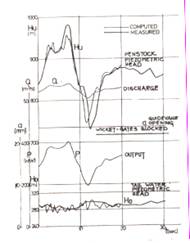
Fig. 4 Transient Calculations versus Field Test Results.
Low specific speed unstable
“S” form pump-turbine four-quadrant curves is the source of severe transients
even at one unit load rejection while other unit continues normal operation.
Quick change of flow from turbine to pump direction results in sudden pressure
jump and drop. Water column separation occurred in the draft tube and pressure
jumped up to 10 bar when separated water columns rejoined. Recommendation: Each
low specific speed pump-turbine should have its own penstock and tailrace.
Pump-Turbines for Bajina Basta
The World wide five best companies had been carefully analyzed as potential manufacturers for Bajina Basta pump-turbines. Two of them had been selected for model tests. TOSHIBA's units are in operation.
Hydraulic Vibration and Stability Analyses
Hydraulic vibration and stability had been analyzed in frequency domain. In the "S" zone of four quadrant machine characteristics, system is unstable. Both wicket gates and penstock valves are constructed to prevent runaway in this dangerous unstable transient operating zone..
Self-Excited Vibrations
Self excited vibrations had been analyzed. System designed to prevent them.
Site Measurements
Measured data of transient regimes ware compared with the theoretical computer simulations. Agreement was good (See Fig. 4).
Measured machine properties confirmed the quality of the units in operation.
Back to
Back Start in Pumping Mode of Operation
Vibrations
of Turbine Units of Hydro Power Plant "Bajina Basta" during Back to
Back Start in Pumping Mode of Operation the Pump-Turbines of Pumped Storage
Power Plant "Bajina Basta" were analyzed in order to reduce excessive
amplitudes of bearing displacement.
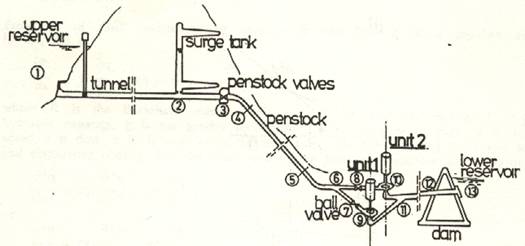
Bajina Basta Cross-section

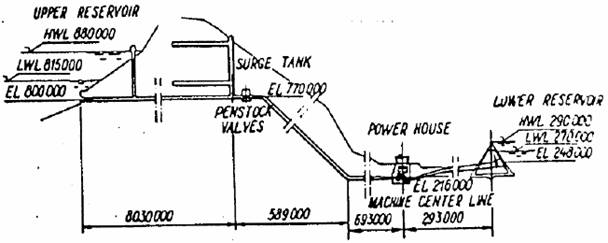
Photo
Bajina Basta Power Plant (4x90 MW)
and
Pumped Storage Power Station Bajina Basta (2X300 MW)
Papers, Studies, Analyses, Troubleshooting, Simulations…
<Home Page> click here.